Audio gear
Audio Accessories Worth Packing
Viewers forgive soft footage far more readily than bad sound. A small amount of the right audio gear changes perceived quality faster than anything else you can buy.
In this guide
Three microphone types and their jobs
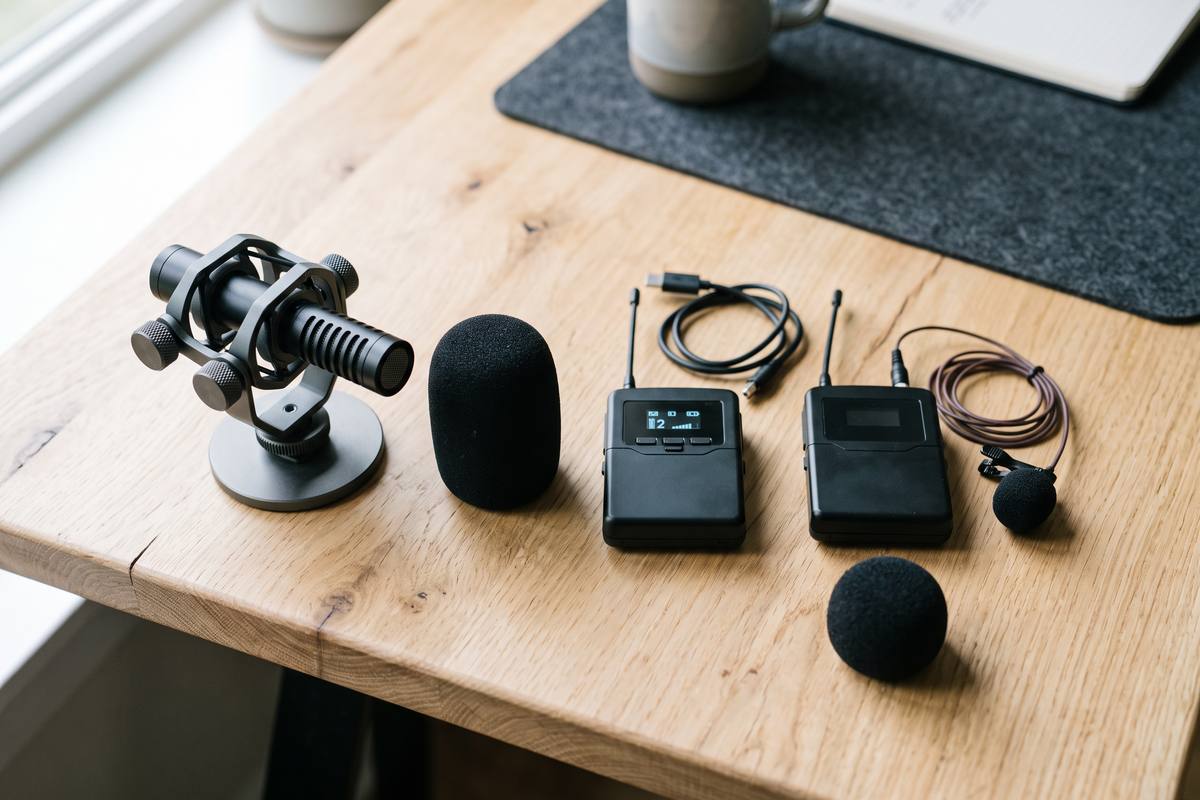
A clip-on microphone placed on the speaker's clothing captures the voice directly and rejects most of the room. It is the most reliable option for talking video, and it is placed on the body that stays a consistent distance from the mouth.
A compact directional microphone on the camera is better for recording a space: ambience, a scene, a demonstration where the sound comes from the frame rather than from a person. A wireless kit solves cable length and movement, at the cost of batteries, pairing and an extra failure point.
- Clip-on lavalier: best for speech and interviews, closest to the source
- Directional mic on camera: best for ambience and action, more room sound
- Wireless kit: best for movement and distance, needs charged batteries
- Phone built-in mic: excellent ambience, poor speech beyond arm's length
Placement beats specification
A modest microphone twenty centimetres from the mouth will outperform an expensive microphone two metres away, every time. Place the microphone on the side of the chest facing away from the camera if you can, and use a windscreen and a clip to hold it in position.
When using a directional microphone on the camera, get as close to the subject as the framing allows. In a vertical close-up this is easy; in a wide shot it is not, which is the practical argument for the on-body microphone.
Wind, traffic and room noise
Wind ruins more outdoor audio than any other cause, and it is nearly impossible to remove afterwards. A foam windscreen, or a furry cover over it, costs very little and solves most of the problem.
For traffic and room noise, record fifteen seconds of the empty space before the take. That ambient recording is what editing tools use to reduce background sound, and without it the reduction is guesswork.
Cables, adapters and the practical setup
Phone microphones need the right adapter and, on some phones, the camera app must be told which input to use. Test the chain from microphone to recording before you leave, not on location.
Keep one spare cable in the bag and label both. Cable failure is the most common cause of silent footage, and it is the cheapest failure to prevent.
Key takeaways
- For speech, use a clip-on microphone as close to the mouth as practical.
- Use a directional microphone when the sound belongs to the scene.
- Always record room ambience for fifteen seconds before a take.
- Test the entire audio chain before travelling to the shoot.
ReelKit Studio editorial teamWe buy and carry this equipment ourselves. Nothing on this site is sponsored, and we describe the free alternative before any purchase.
Can I fix bad audio afterwards?
Steady noise can be reduced if you recorded ambient sound, and levels can be balanced. Wind, clipping and distance cannot be repaired convincingly.
Is a wireless kit necessary?
Only for movement or when the speaker is far from the camera. A cable is more reliable, cheaper and sounds identical at the same distance.
Do I need headphones while filming?
Even basic wired earphones let you confirm that sound is actually recording. It is the simplest insurance against a silent shoot.